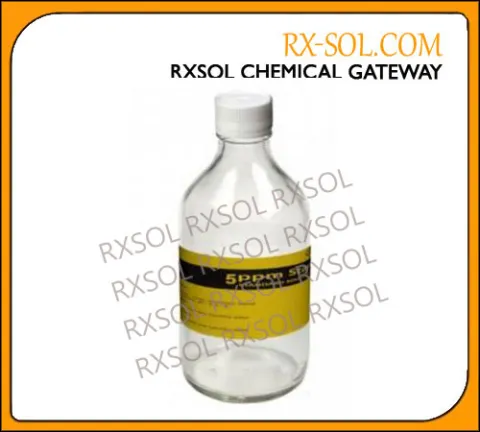
Sodium Thiosulfate LR Grade POWDER
- Part number
- RXSOL-60-6156-001
- Category
- Wall Wash Test Kit
- Brand
- RXSOL
Overview
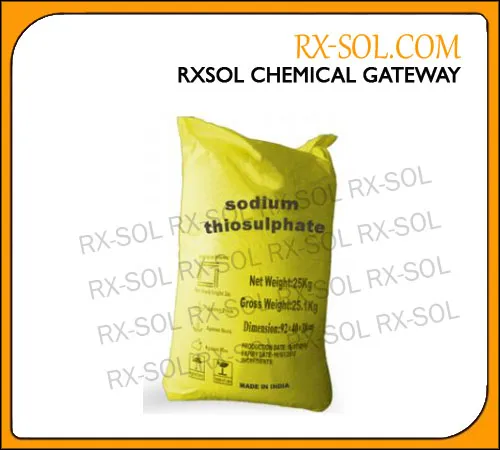
Sodium Thiosulfate pure LAB GRADE materials
Molecular Formula ::: Na2S2O3 - 5H2O
Technical specifications
Other names:Sodium hyposulfite ,Hyposulphite of soda
| Identifiers CAS number | 7772-98-7 Y, 10102-17-7 : (pentahydrate) |
|---|
UNII :L0IYT1O31N Y
| ChEMBL CHEMBL | 1201157 N |
|---|---|
| ChEMBL CHEMBL | 1201157 N |
|||
| 100 °C (pentahydrate, | 5H2O decomp) |
|---|
Identifiers
| CAS number | 7772-98-7 Y, |
|---|---|
| 10102-17-7 | (pentahydrate) |
| PubChem | 4477 |
Applications
laboratory synthesis
In the laboratory, this salt can be prepared by heating an aqueous solution of sodium sulphite with sulphur.
Principal reactions and applications
Thiosulfate anion characteristically reacts with dilute acids to produce sulfur, sulfur dioxide and water-
1.Na2S2O3 + 2HCl →2NaCl + S + SO2 + H2O
This reaction is known as a "clock reaction", because when the sulfur reaches a certain concentration the solution turns from colourless to a pale yellow. This reaction has been employed to generate colloidal sulfur. When the protonation is conducted at low temperatures, H2S2O3 (thiosulfuric acid) can be obtained. It is a somewhat strong acid with pKas of 0.6 and 1.7 for the first and second dissociation respectively.
Iodometry
In analytical chemistry, the most important use comes from the fact that the thiosulfate anion reacts stoichiometrically with iodine, reducing it to iodide as it is oxidized to tetrathionate:
Photographic processing
The terminal sulfur atom in S2O32− binds to soft metals with high affinity. Thus, silver halides, e.g. AgBr, typical components of photographic emulsions, dissolve upon treatment with aqueous thiosulfate:
2 S2O32− + AgBr →[Ag(S2O3)2]3−+ Br−
In this application to photographic processing, discovered by John Herschel and used for both film and photographic paper processing, the sodium thiosulfate is known as a photographic fixer, and is often referred to as hypo, from the original chemical name, hyposulphite of soda.
Gold extraction
Sodium thiosulfate is one component of an alternative lixiviant to cyanide for extraction of gold.[3] It forms a strong complex with gold(I) ions, [Au(S2O3)2]3−. The advantage of this approach is th
2 S2O32−(aq) + I2(aq) →S4O62−(aq) + 2 I−(aq)
Due to the quantitative nature of this reaction, as well as the fact that Na2S2O3•5H2O has an excellent shelf-life, it is used as a titrant in iodometry. Na2S2O3•5H2O is also a component of iodine clock experiments.
This particular use can be set up to measure the oxygen content of water through a long series of reactions. It is also used in estimating volumetrically the concentrations of certain compounds in solution (hydrogen peroxide, for instance) and in estimating the chlorine content in commercial bleaching powder and water.at thiosulfate is essentially non-toxic and that ore types that are refractory to gold cyanidation (e.g. carbonaceous or Carlin type ores) can be leached by thiosulfate. Some problems with this alternative process include the high consumption of thiosulfate, and the lack of a suitable recovery technique, since [Au(S2O3)2]3− does not adsorb to activated carbon, which is the standard technique used in gold cyanidation to separate the gold complex from the ore slurry.
Dosage and directions
Process for DE CHLORINATION :::
Dissolve the 500 grams of Sodium Thiosulfate in a large pitcher of lukewarm tap water. Stir until all the crystals are dissolved. Then transfer the solution with a funnel to the gallon jug. Top off the jug to make a full gallon of stock solution.
- Add two drops of the stock solution per one gallon of the water to be treated.
- One gallon can treat 37,850 gallons or more. Over-dosage is virtually impossible.
Characteristics and notes
Analytical chemistry
Sodium thiosulfate is also used in analytical chemistry. It can, when heated with a sample containing aluminum cation, produce a white precipitation:
2 Al3+ + 3 S2O32− + 3 H2O →3 SO2 + 3 S + 2 Al(OH)3
Medical
It is used as an antidote to cyanide poisoning. Thiosulfate acts as a sulfur donor for the conversion of cyanide to thiocyanate (which can then be safely excreted in the urine), catalyzed by the enzyme rhodanase.
It has also been used as treatment of calciphylaxis in hemodialysis patients with end-stage renal disease.[6]
It is used in the management of extravasations during chemotherapy. Sodium thiosulfate prevents alkylation and tissue destruction by providing a substrate for the alkylating agents that have invaded the subcutaneous tissues. The dose may be 2mL of 0.17M (a solution of 4mL 10% sodium thiosulfate and 6mL sterile water for injection). It may be instilled subcutaneously into multiple sites using a small gauge needle. There is limited data on this method with few recommendations.
in foot baths for prophylaxis of ringworm, and as a topical antifungal agent for tinea versicolor.
in measuring the volume of extracellular body fluid and the renal glomerular filtration rate.
Sodium thiosulfate is also used:
As a component in hand warmers and other chemical heating pads that produce heat by exothermic crystallization of a supercooled solution.
In bleach
In pH testing of bleach substances. The universal indicator and any other liquid pH indicators are destroyed by bleach, rendering them useless for testing the pH. If one first adds sodium thiosulfate to such solutions, it will neutralize the color-removing effects of bleach and allow one to test the pH of bleach solutions with liquid indicators. The relevant reaction is akin to the iodine reaction: thiosulfate reduces the hypochlorite (active ingredient in bleach) and in so doing becomes oxidized to sulfate. The complete reaction is:
4 NaClO + Na2S2O3 + 2 NaOH →4 NaCl + 2 Na2SO4 + H2O
To dechlorinate tap water for aquariums or treat effluent from waste water treatments prior to release into rivers. The reduction reaction is analogous to the iodine reduction reaction. Treatment of tap water requires between 0.1 grams and 0.3 grams of pentahydrated (crystalline) sodium thiosulfate per 10 liters of water.
To lower chlorine levels in swimming pools and spas following super chlorination.
To remove iodine stains, e.g. after the explosion of nitrogen triiodide.
Similarly, sodium thiosulfate reacts with bromine to render harmless products. Solutions of sodium thiosulfate are commonly used as a precaution in chemistry laboratories when working with bromine.
In bacteriological water assessment.
In the tanning of leather.
To demonstrate the concept of reaction rate in chemistry classes. The thiosulfate ion can decompose into the sulfite ion and a colloidal suspension of sulfur, which is opaque. The equation for this acid-catalysed reaction is as follows:
S2O32−(aq) →SO32−(aq) + S(s)
To demonstrate the concept of supercooling in physics classes. Melted sodium thiosulfate is very easy to overcool to room temperature and when crystallization is forced, the sudden temperature jump to 48.3 °C can be experienced by touch.
As part of patina recipes for copper alloys.
Often used in pharmaceutical preparations as an anionic surfactant to aid in dispersion.
It can also be used as a very interesting solute in supersaturation experiments.
Safety and SDS
Read the safety data sheet before handling. Wear suitable gloves and eye protection.
View safety data sheet
| Product Name |
Sodium Thiosulfate Pentahydrate |
| Part Number | RXSOL-19-2031-050 |
Company Details:
RX MARINE INTERNATIONAL
105, A wing , BSEL , TECH PARK.
VASHI ,NEW BOMBAY 400703 INDIA
Stock Point : Mumbai, Chennai, Kandla, Kolkata, Visakhapatnam, Fujairah
| Phone | +91 22 27815541 / 42 / 43 |
| Fax | +91 22 2781 1318 :::AOH :0091 9821214367 |
| rxsolchemicals@gmail.com | |
| Website | www.rxmarine.com |
Synonym: Ametox, Antichlor; Sodium Hyposulfite, Pentahydrate
Chemical Name: Thiosulfuric Acid, disodium salt, Pentahydrate
Chemical Formula: Na2S2O3.5H20
| Component | CAS-No | Weight % |
| Sodium Thiosulfate Pentahydrate | 10102-17-7 | 100 % |
| Signal Word | : | Irritant |
| Potential Acute Health Effects: | : | Hazardous in case of ingestion, of inhalation. Slightly hazardous in case of skin contact (irritant), of eye contact (irritant). |
| Potential Chronic Health Effects: | : | Slightly hazardous in case of skin contact (irritant, sensitizer). CARCINOGENIC EFFECTS: Not available. MUTAGENIC EFFECTS: Not available. TERATOGENIC EFFECTS: Not available. DEVELOPMENTAL TOXICITY: Not available. |
| Eye Contact : |
Check for and remove any contact lenses. In case of contact, immediately flush eyes with plenty of water for at least 15 minutes. Cold water may be used. Get medical attention if irritation occurs. |
| Skin Contact: | Wash with soap and water. Cover the irritated skin with an emollient. Get medical attention if irritation develops. Cold water may be used. |
| Serious Skin Contact: | Not available |
| Inhalation: |
If inhaled, remove to fresh air. If not breathing, give artificial respiration. If breathing is difficult, give oxygen. Get medical attention. |
| Serious Inhalation: | Not available. |
| Ingestion: | Do NOT induce vomiting unless directed to do so by medical personnel. Never give anything by mouth to an unconscious person. If large quantities of this material are swallowed, call a physician immediately. Loosen tight clothing such as a collar, tie, belt or waistband.. |
| Serious Ingestion | Not available. |
Flammability of the Product: Non-flammable.
Auto-Ignition Temperature: Not applicable.
Flash Points: Not applicable.
Flammable Limits: Not applicable.
Products of Combustion: Not available.
Fire Hazards in Presence of Various Substances: Not applicable.
Explosion Hazards in Presence of Various Substances:
Risks of explosion of the product in presence of mechanical impact: Not available.
Risks of explosion of the product in presence of static discharge: Not available.
Fire Fighting Media and Instructions: Not applicable.
Special Remarks on Fire Hazards: When heated to decomposition it emits toxic fumes of sulfur oxides, hydrogen sulfide, and sodium oxide.
Special Remarks on Explosion Hazards: An explosion may occur if triturated with nitrates, chlorates, or permanganates.
Small Spill:
Use appropriate tools to put the spilled solid in a convenient waste disposal container. Finish cleaning by spreading water on the
contaminated surface and dispose of according to local and regional authority requirements.
Large Spill:
Use a shovel to put the material into a convenient waste disposal container. Finish cleaning by spreading water on the contaminated
surface and allow to evacuate through the sanitary system
Precautions:
Do not breathe dust. Wear suitable protective clothing. In case of insufficient ventilation, wear suitable respiratory equipment.
If you feel unwell, seek medical attention and show the label when possible. Keep away from incompatibles such as oxidizing
agents, acids, alkalis.
Storage: Hygroscopic. Keep container tightly closed. Keep container in a cool, well-ventilated area.
Engineering Controls:
Use process enclosures, local exhaust ventilation, or other engineering controls to keep airborne levels below recommended
exposure limits. If user operations generate dust , fume or mist, use ventilation to keep exposure to airborne contaminants
below the exposure limit.
Personal Protection:
Safety glasses. Lab coat. Dust respirator. Be sure to use an approved/certified respirator or equivalent. Gloves.
Personal Protection in Case of a Large Spill:
Splash goggles. Full suit. Dust respirator. Boots. Gloves. A self contained breathing apparatus should be used to avoid
inhalation of the product. Suggested protective clothing might not be sufficient; consult a specialist BEFORE handling this product.
Exposure Limits: Not available.
Gloves Suit
| Physical State | : | Solid |
| Colour & Appearance | : | White Powder/Granular |
| Odour | : | Odourless |
| Taste | : | Saline |
| Molecular Weight | : | 248.19 g/mole |
| PH | : | 5% solution: 6.0-8.4 |
| Boiling Point/Range | : | >100°C (212°F) |
| Melting / Freezing Point | : | 48°C (118.4°F) |
| Critical Temperature | : | Not available. |
| Specific Gravity | : | 1.7 - 1.75(Water = 1). |
| Vapor Pressure | : | Not Applicable |
| Vapor Density | Not available. | |
| Volatility Density | : | Not Available |
| Odor Threshold | : | Not Available |
| Water/Oil Dist. Coeff | : | Not Available |
| Partition coefficient n octanol/water | : | Not available. |
| Ionicity (in Water) | : | Not available |
| Dispersion Properties | : | See solubility in water |
| Solubility | : | Soluble in cold water, hot water. Solubility in water: 79 g/100 ml @ 4 deg. C (39 deg. F) 680 g/liter @ 20 deg. C |
| Stability | : | The product is stable. |
| Instability Temperature | : | Not available. |
| Conditions of Instability | : | Incompatible materials,Moisture |
| Incompatibility with various substances | : | Reactive with oxidizing agents, acids, alkalis. |
| Corrosivity | Non-corrosive in presence of glass. | |
| Special Remarks on Reactivity | It is a strong reducing and can react with oxidizers. Reacts with acids to release sulfur dioxide. Sodium Thiosulfate pentahydrate dissolves in its own water of hydation; it effloresces in warm dry air. Sodium Thiosulfate pentahydrate loses water at 100 deg. C. It is incompatible with iodine, acids, lead, mercury, and silver salts (e.g. silver nitrate), halogens. Hygroscopic; keep container tightly closed. Protect from moisture | |
| Special Remarks on Corrosivity | Not Available | |
| Polymerization | Will not occur. |
| Routes of Entry | Inhalation. Ingestion. | |
| Toxicity to Animals | LD50: Not available. LC50: Not available | |
| Chronic Effects on Humans | Not available | |
| Other Toxic Effects on Humans | Hazardous in case of ingestion, of inhalation. Slightly hazardous in case of skin contact (irritant). | |
| Special Remarks on Toxicity to Animals | Not available. | |
| Special Remarks on Chronic Effects on Humans | Not available | |
| Special Remarks on other Toxic Effects on Humans | Acute Potenial Health Effects: Skin: It may cause mild skin irritation. Eyes: Can cause mechanical eye irritation. Inhalation: May cause upper respiratory tract and mucous membrane irritation. Ingestion: Sodium Thiosulfate is an agent with a low order of toxicity. Ingestion of large doses may cause gastrointestinal irritation disturbances with nausea, vomiting, addominal cramping, diarrhea, metabolic acidosis, and hypernatremia. May also affect respiration (cyanosis, respiratory stimulation), cardiovascular(hypotension), behavior (ataxia, convulsions) Chronic Potential Health Effects: Skin: Prolonged or repeated skin contact may allergic dermatitis, and irritation. The toxicological preperties of this substance have not been fully investigated |
| Ecotoxicity: | Not available. |
| BOD5 and COD: | Not available. |
| Products of Biodegradation : | Possibly hazardous short term degradation products are not likely. However, long term degradation products may arise. |
| Toxicity of the Products of Biodegradation: | The product itself and its products of degradation are not toxic. |
| Special Remarks on the Products of Biodegradation: | Not available. |
Waste Disposal: Waste must be disposed of in accordance with federal, state and local environmental control regulations
DOT Classification: Not a DOT controlled material (United States).
Identification: Not applicable.
Special Provisions for Transport: Not applicable.
Federal and State Regulations: No products were found.
Other Regulations: Not available.
Other Classifications:
WHMIS (Canada): Not controlled under WHMIS (Canada).
DSCL (EEC):
This product is not classified according to the EU regulations. S24/25- Avoid contact with skin and eyes. S28- After contact
with skin, wash immediately with plenty of water. S37- Wear suitable gloves. S45- In case of accident or if you feel unwell,
seek medical advice immediately (show the label where possible).
HMIS (U.S.A.):
Health Hazard: 2
Fire Hazard: 0
Reactivity: 0
Personal Protection: E
National Fire Protection Association (U.S.A.):
Health: 2
Flammability: 0
Reactivity: 0
Specific hazard:
Protective Equipment:
Gloves. Lab coat. Dust respirator. Be sure to use an approved/certified respirator or equivalent. Splash goggles.
The information above is believed to be accurate and represents the best information currently available to us. However, we make no
warranty of merchantability or any other warranty, express or implied, with respect to such information, and we assume no liability resulting
from its use. Users should make their own investigations to determine the suitability of the information for their particular purposes. In no
event shall be liable for any claims, losses, or damages of any third party or for lost profits or any special, indirect, incidental, consequential
or exemplary damages, howsoever arising, even if Rx Marine International has been advised of the possibility of such damages.
DISCLAIMER OF LIABILITY :The information in this SDS was obtained from sources which we believe are reliable. However, the information is provided without any warranty, express or implied, regarding its correctness. The conditions or methods of handling, storage, use or disposal of the product are beyond our control and may be beyond our knowledge. For this and other reasons, we do not assume responsibility and expressly disclaim liability for loss, damage or expense arising out of or in any way connected with the handling, storage, use or disposal of the product. This MSDS was prepared and is to be used only for this product. If the product is used as a component in another product, this MSDS information may not be applicable.
Availability
Sodium Thiosulfate manufacturer and supplier in Mumbai, Kandla, Kolkata, Chennai, Visakhapatnam, Fujairah, Dubai, Ajman, Abudhabi, Sharjah, Muscat, Oman.