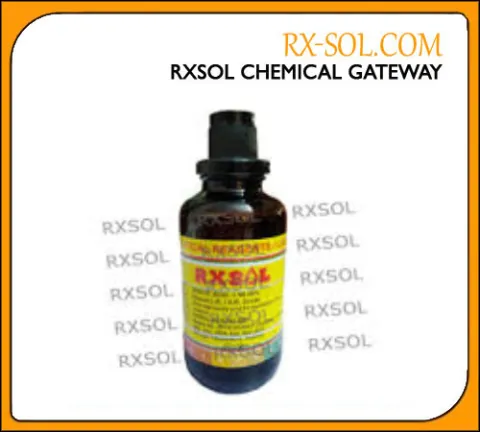
TOTAL CHLORINE BUFFER SOLUTION 500 ml
- Part number
- RXSOL-60-6206-050
- Category
- Lab Chemical
- Brand
- RXSOL
Overview
Applications
Dosage and directions
Characteristics and notes
Safety and SDS
Read the safety data sheet before handling. Wear suitable gloves and eye protection.
View safety data sheet
| Product Name | : TOTAL CHLORINE BUFFER SOLUTION 500 ml |
| Part Number | : RXSOL-60-6206-050 |
Company Details:
RX MARINE INTERNATIONAL
105, A wing , BSEL , TECH PARK.
VASHI ,NEW BOMBAY 400703 INDIA
Stock Point : Mumbai, Kandla, Kolkata, Chennai, Vizag, Fujairah, Muscat, Nairobi
| Phone | +91 22 20871200-1400 |
| Fax | +91 22 20871500:::AOH :0091 9821214367 |
| rxsolchemicals@gmail.com | |
| Website | www.rxmarine.com |
| Name of Substance | Cas Number | Wt.% |
| Deionized Water | 7732-18-5 | >75% |
| Trisodium Citrate Salt | 68-04-2 | <15% |
| Potassium Iodide | 7681-11-0 | <10% |
| EDTA | 6381-92-6 | <1% |
| Signal Word | Warning |
| Hazard Statements |
H373 May cause damage to the thyroid through prolonged or repeated exposure. Route of exposure: Oral |
| Classification | GHS08 health hazard. The product is classified and labelled according to the GB CLP regulation. |
| Precautionary statements |
P264 Wash hands thoroughly after handling.
P314 Get medical advice/attention if you feel unwell.
|
| Other hazards | The main intake pathways of potassium iodide are: inhalation of dust and solution aerosols, as well as oral ingestion. |
| Results of PBT and vPvB |
This mixture does not contain any substances that are assessed to be persistent, bioaccumulative and toxic (PBT) or very
persistent and very bioaccumulative (vPvB), according to the criteria given in Annex XIII of Regulation (EC) No. 1907/2006.
|
| Determination of endocrine-disrupting properties | The product does not contain substances with endocrine disrupting properties. |
| General information | Instantly remove any clothing soiled by the product. |
| Eye Contact | Rinse opened eye for several minutes under running water (at least 15 min). If symptoms persist, consult doctor. |
| Skin Contact | Instantly wash with water and soap and rinse thoroughly. |
| Inhalation | Supply fresh air; consult doctor in case of symptoms. |
| Ingestion |
Rinse out mouth and then drink 1-2 glasses of water.
In case of persistent symptoms consult doctor.
|
| Notes to Physicians | Absorption: in case of iodine hypersensitivity, even after relatively low doses, acute respiratory and cardiovascular disorders (possibly shock), skin and mucous membrane reactions possible. (GESTIS) Symptoms of poisoning may even occur after several hours. |
| symptoms and effects | irritations, after swallowing of large amounts, headache, vomiting, absorption, weakness, disorder of electrolyte balance. |
| Suitable extinguishing media | Use fire fighting measures that suit the environment. |
| Protective Equipment | Wear self-contained breathing apparatus. |
| Advice for firefighters | Wear full protective suit. |
| Specific extinguishing methods | The product is not combustible. Formation of toxic gases is possible during heating or in case of fire. Can be released in case of fire: Hydrogen iodide (HI) Carbon monoxide (CO) and carbon dioxide (CO2). |
| Addition information |
Collect contaminated fire fighting water separately. It must not enter drains.
Dispose of fire debris and contaminated fire fighting water in accordance with official regulations.
Ambient fire may liberate hazardous vapours.
|
| Personal precautions, protective equipment and emergency procedures | Advice for non-emergency personnel: Wear protective equipment. Keep unprotected persons away. Ensure adequate ventilation Advice for emergency responders: Protective equipment: |
| Enviromental Precaution | Do not allow product to reach sewage system or water bodies. Dilute with much water. |
|
Methods and materials for containment and cleaning up |
Ensure adequate ventilation. Absorb with liquid-binding material (sand, diatomite, universal binders). Dispose of contaminated material as waste according to item 13. |
| Advice on safe handling | Prevent formation of aerosols. |
| Storage | Store in cool location. Protect from heat and direct sunlight. Protect from the effects of light. Protect from humidity and keep away from water. |
| Advice on general occupational hygiene | Take off immediately all contaminated clothing. Wash hands during breaks and at the end of the work. Do not eat, drink or smoke when using this product. |
| Engineering Control | The product does not contain any relevant quantities of materials with critical values that have to be monitored at the workplace. |
| Personal Protection | Eye protection: Safety glasses, use against the effects of fumes / dust, Use safety glasses that have been tested and approved in accordance with government standards such as EN 166. Hand protection : Preventive skin protection by use of skin-protecting agents is recommended. After use of gloves apply skin-cleaning agents and skin cosmetics. Skin protection :Protective work clothing. Use breathing protection against the effects of fumes/dust/aerosol. personal protective equipment Protective clothing should be selected specifically for the workplace, depending on concentration and quantity of the hazardous substances handled. |
| Hygiene measures | Technical measures and appropriate working operations should be given priority over the use of personal protective equipment. |
Gloves Suit
| Physical State | Fluid |
| Colour | Colourless |
| Odour | Odourless |
| Boiling point and boiling range | Not determined. |
| Flash Point | Not determined. |
| Freezing Point | No data available |
| pH | 6.7 |
| Evaporation rate | No data available |
| Flammability (solid, gas) | The product is not combustible. |
| Upper explosion limit | No data available |
| Lower explosion limit | No data available |
| Explosive properties | Product is not explosive |
| Vapor pressure | Not determined. |
| density at 20°C | ~1.1 g/cm³ |
| Relative density | Not determined. |
| Water solubility | 80% |
| Water | Fully miscible |
| Solids content | 10-20% |
| Corrosive to metals | void |
| Solubility in other solvents | No data available |
| Partition coefficient: octanol | No data available |
| Autoignition temperature | No data available |
| Thermal decomposition | No data available |
| Viscosity, kinematic | No data available |
| Explosive properties | No data available |
| Organic solvents | 0% |
| Oxidizing properties | None |
| Molecular weight | No data available |
| VOC | No data available |
| Recativity | None |
| Stability | Stable at ambient temperature (room temperature). |
| Possibility of hazardous reactions | Reacts with oxidizing agents. |
| Condition to Avoid | Strong heating (decomposition) |
| Polymerization | No further relevant information available. |
| Route of Exposure |
At workplaces, intake of potassium iodide (KI) is most likely to occur via the respiratory tract.
Outside the workplace, iodides are ingested with food (essential) and sometimes with medications.
Respiratory tract: KI can be inhaled as dust or aerosol from solutions. Inhalation studies were conducted with particulate aerosols
containing sodium iodide using various animal species (monkey, mouse, sheep). Rapid and effective absorption via the
respiratory tract was observed. This is also assumed for KI as its solubility is comparable.
Skin: From tests on volunteers who had an aqueous KI solution applied to their forearms (12.5 cm²), the amount of iodine
absorbed was estimated at 0.1%. Absorption through the skin is therefore considered to be of little relevance.
Gastrointestinal tract: Soluble iodide is absorbed almost entirely via the gastrointestinal tract. This has been proven by results of
studies with KI on adult volunteers.
|
| Eyes |
Based on available data, the classification criteria are not met. |
| Skin | Based on available data, the classification criteria are not met. |
| Ingestion | Causes digestive tract burns |
| Chronic Exposure | Health injuries are not known or expected under normal use. |
| classification |
Based on available data, the classification criteria are not met.
May cause damage to the thyroid through prolonged or repeated exposure. Route of exposure: Oral.e
|
| additional information |
Other dangerous properties can not be excluded. According to the information available to us, the chemical, physical and toxicological properties of the substances mentioned in Chapter 3 have not been thoroughly investigated.
|
| Environmental Effects | No data available |
| Toxicity to fish | No data available |
| Toxicity to daphnia and others | No data available |
| Toxicity to algae | No data available |
| Persistence and degradability | No data available |
| Bioaccumulative potential | No data available |
| Mobility in soil | No data available |
| additional information |
Water hazard:
Do not allow product to reach ground water, water bodies or sewage system, even in small quantities.
Danger to drinking water if even extremely small quantities leak into soil.
|
| Waste Disposal | Must not be disposed of together with household garbage. Do not allow product to reach sewage system. Hand over to disposers of hazardous waste. |
Hazard Pictograms:
| UN Number | Void |
| Proper shipping name | Void |
| Transport hazard class(es) 8 | |
| ADR/RID | Void |
| Subsidiary risk IMDG | Void |
| Subsidiary risk IATA | Void |
| Packing group | |
| Packing group | Not applicable. |
| Environmental hazards | |
| Environmental hazards | Not applicable. |
| Marine pollutant | Not applicable. |
| ADR/RID | |
| Hazard ID | Not applicable. |
| Tunnel Category | (E) |
| IMDG | |
| EmS Code | Void |
| IATA | |
| Packing Instruction (Cargo) | Not applicable. |
| Maximum quantity | |
| Packing Instruction (Passenger) | void |
| Maximum quantity | |
| Regulations | None of the ingredients is listed. |
| Chemical safety assessment | A Chemical Safety Assessment has not been carried out. |
| Further information | Employment restrictions concerning young persons must be observed (94/33/EC). |
| Other Information |
The information above is believed to be accurate and represents the best information currently available to us. However, we make no warranty of merchantability or any other warranty, express or implied, with respect to such information, and we assume no liability resulting from its use. Users should make their own investigations to determine the suitability of the information for their particular purposes. In no event shall be liable for any claims, losses, or damages of any third party or for lost profits or any special, indirect, incidental, consequential or exemplary damages, howsoever arising, even if Rx Marine International has been advised of the possibility of such damages. DISCLAIMER OF LIABILITY :The information in this SDS was obtained from sources which we believe are reliable. However, the information is provided without any warranty, express or implied, regarding its correctness. The conditions or methods of handling, storage, use or disposal of the product are beyond our control and may be beyond our knowledge. For this and other reasons, we do not assume responsibility and expressly disclaim liability for loss, damage or expense arising out of or in any way connected with the handling, storage, use or disposal of the product. This MSDS was prepared and is to be used only for this product. If the product is used as a component in another product, this MSDS information may not be applicable. |
Availability
TOTAL CHLORINE BUFFER SOLUTION manufacturer supplier distributor in Mumbai, Kandla, Kolkata, Vizag, Chennai, India, Fujairah, Dubai, Sharjah, UAE, Gulf, Middle East, Muscat Oman, Kenya Africa. Get the best quality of TOTAL CHLORINE BUFFER SOLUTION at a competitive price from us. We have ready stock of TOTAL CHLORINE BUFFER SOLUTION in India, UAE Gulf, Oman, Kenya Africa. Contact us for bulk as well as small orders.