Overview
If RXH is not acid enough to release a proton at alkaline pH, as it is the case with amines, then the reaction has to be carried out in two steps. During the first step the first EO mole is added at acid pH, so that the amine is transformed in ammonium. The reaction produce the mono-, di- and tri-ethanol amines.
Proton release from ammonium NH4+ → NH3 + H+ (here RX- is NH3) Then, the three condensation reactions:
NH3 + EO → NH2CH2CH2OH (mono-ethanol amine MEA)
NH2CH2CH2OH + EO → NH(CH2CH2OH)2 (di-ethanol amine DEA)
NH-(CH2CH2OH)2 + EO → N(CH2CH2OH)3 (tri-ethanol amine TEA)
With an alkyl amine, first the alkyl ammoniumion is formed and it is deprotonated:
RNH3+ → RNH2 + H+ (here RX- is RNH2)
RNH2 + EO → RNH-CH2CH2OH (mono-ethanol alkyl amine)
RNH-CH2CH2OH + EO → RN(CH2CH2OH)2 (di-ethanol alkyl amine)
Once the ethanol amine is attained, the EO polycondensation is carried out at alkaline pH as previously. In many instance the first ethoxylation is stopped when the monoethanol alkyl amine is formed in order to avoid the polycondensation in more than one chain.
Safety and SDS
Read the safety data sheet before handling. Wear suitable gloves and eye protection.
View safety data sheet
| Product Code | RXSOL-60-6003-500 |
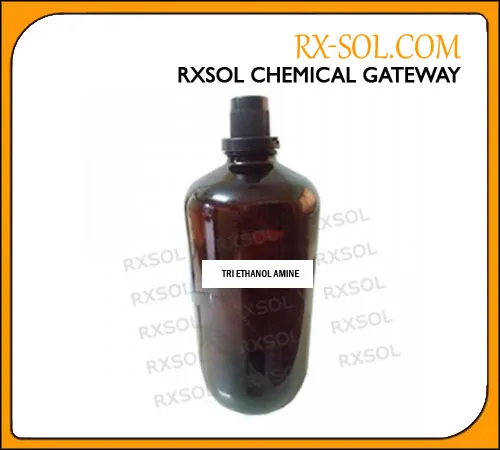
| Product Name | Triethanolamine |
Company Details:
RX MARINE INTERNATIONAL
105, A wing , BSEL , TECH PARK.
VASHI ,NEW BOMBAY 400703 INDIA
| Phone | +91 22 65113333 / 5555 / 9999 |
| Fax | +91 22 2781 1318 :::AOH :0091 9821214367 |
| rxsolchemicals@gmail.com |
Composition:
| Name | CAS # | % by Weight |
| Triethanolamine | 102-71-6 | 100 |
Toxicological Data on Ingredients: Triethanolamine: ORAL (LD50): Acute: 2200 mg/kg [Guinea pig]. 5846 mg/kg [Mouse]. 2200 mg/kg [Rabbit].
Potential Acute Health Effects:
Hazardous in case of skin contact (permeator), of eye contact (irritant), of ingestion, of inhalation. Slightly hazardous in case of skin contact (irritant).
Potential Chronic Health Effects:
CARCINOGENIC EFFECTS: 3 (Not classifiable for human.) by IARC. MUTAGENIC EFFECTS: Mutagenic for mammalian somatic cells. TERATOGENIC EFFECTS: Not available. DEVELOPMENTAL TOXICITY: Not available. The substance may be toxic to kidneys, liver, skin. Repeated or prolonged exposure to the substance can produce target organs damage.
| Eye Contact: | Check for and remove any contact lenses. Immediately flush eyes with running water for at least 15 minutes, keeping eyelids open. Cold water may be used. Get medical attention. Finish by rinsing thoroughly with running water to avoid a possible infection. |
| Skin Contact: | Wash with soap and water. Cover the irritated skin with an emollient. Get medical attention if irritation develops. Cold water may be used. |
| Serious Skin Contact: | Wash with a disinfectant soap and cover the contaminated skin with an anti-bacterial cream. Seek medical attention. |
| Inhalation: | If inhaled, remove to fresh air. If not breathing, give artificial respiration. If breathing is difficult, give oxygen. Get medical attention. |
| Serious Inhalation: | Not available. |
| Ingestion: | Do NOT induce vomiting unless directed to do so by medical personnel. Never give anything by mouth to an unconscious person. Loosen tight clothing such as a collar, tie, belt or waistband. Get medical attention if symptoms appear. |
| Serious Ingestion: | Not available. |
| Flammability of the Product: | May be combustible at high temperature. |
| Auto-Ignition Temperature: | Not available. |
| Flash Points: | CLOSED CUP: 179.44°C (355°F). OPEN CUP: 190.5°C (374.9°F) (Cleveland). |
| Flammable Limits: | Not available. |
|
Products of Combustion: |
These products are carbon oxides (CO, CO2). |
| Fire Hazards in Presence of Various Substances: | Slightly flammable to flammable in presence of open flames and sparks, of heat. Non-flammable in presence of shocks. |
| Explosion Hazards in Presence of Various Substances: | Risks of explosion of the product in presence of mechanical impact: Not available. Risks of explosion of the product in presence of staticdischarge: Not available. |
| Fire Fighting Media and Instructions: | SMALL FIRE: Use DRY chemical powder. LARGE FIRE: Use water spray, fog or foam. Do not use water jet. |
| Special Remarks on Fire Hazards: | Not available. |
| Special Remarks on Explosion Hazards: | Not available.A |
Small Spill:
Dilute with water and mop up, or absorb with an inert dry material and place in an appropriate waste disposal container. If necessary: Neutralize the residue with a dilute solution of acetic acid. Finish cleaning by spreading water on the contaminated surface and dispose of according to local and regional authority requirements.
Large Spill:
If the product is in its solid form: Use a shovel to put the material into a convenient waste disposal container. If the product is in its liquid form: Absorb with an inert material and put the spilled material in an appropriate waste disposal. Neutralize the residue with a dilute solution of acetic acid. Finish cleaning by spreading water on the contaminated surface and allow to evacuate through the sanitary system. Be careful that the product is not present at a concentration level above TLV. Check TLV on the MSDS and with local authorities.
Precautions:
Keep locked up.. Keep away from heat. Keep away from sources of ignition. Empty containers pose a fire risk, evaporate the residue under a fume hood. Ground all equipment containing material. Do not ingest. Do not breathe gas/fumes/ vapor/ spray. Wear suitable protective clothing. In case of insufficient ventilation, wear suitable respiratory equipment. If ingested, seek medical advice immediately and show the container or the label. Avoid contact with skin and eyes. Keep away from incompatibles such as oxidizing agents, reducing agents, organic materials, metals, acids.
Storage:
Hygroscopic. Light Sensitive. Store in light-resistant container. Keep container tightly closed. Keep container in a cool, wellventilated area. Do not store above 23°C (73.4°F).
Engineering Controls:
Provide exhaust ventilation or other engineering controls to keep the airborne concentrations of vapors below their respective threshold limit value. Ensure that eyewash stations and safety showers are proximal to the work-station location.
Personal Protection:
Splash goggles. Lab coat. Vapor respirator. Be sure to use an approved/certified respirator or equivalent. Gloves.
Personal Protection in Case of a Large Spill:
Splash goggles. Full suit. Vapor respirator. Boots. Gloves. A self contained breathing apparatus should be used to avoid inhalation of the product. Suggested protective clothing might not be sufficient; consult a specialist BEFORE handling this product.
Exposure Limits:
TWA: 5 from ACGIH (TLV) [United States] [2001] Consult local authorities for acceptable exposure limits.
| Physical state and appearance: | Liquid. (Clear viscous liquid.) |
| Odor: | Ammoniacal. (Slight.) |
| Taste: | Not available. |
| Molecular Weight: | 149.19 g/mole |
| Color: | Colorless to light yellow. |
| pH (1% soln/water): | 10 [Basic.] |
| Boiling Point: | 335°C (635°F) |
| Melting Point: | 21.5°C (70.7°F) |
| Critical Temperature: | Not available. |
| Specific Gravity: | 1.12 (Water = 1) |
| Vapor Pressure: | 0 kPa (@ 20°C) |
| Vapor Density: | 5.1(Air = 1) |
| Volatility: | Not available. |
| Odor Threshold: | Not available. |
| Water/Oil Dist. Coeff.: | The product is more soluble in water; log(oil/water) = -1 |
| Ionicity (in Water): | Not available. |
| Dispersion Properties: | See solubility in water, methanol, acetone. |
| Solubility: | Easily soluble in cold water, hot water. Soluble in methanol, acetone. Very slightly soluble in diethyl ether, n-octanol. |
| Stability: | The product is stable. |
| Instability Temperature: | Not available. |
| Conditions of Instability: | Excess heat, light, exposure to air, exposure to moist air or water, incompatible materials |
| Incompatibility with various substances: |
Highly reactive with oxidizing agents, acids. Reactive with reducing agents, organic materials, metals. Slightly reactive to reactive with moisture. |
| Corrosivity: | Corrosive in presence of steel, of aluminum, of zinc, of copper. Non-corrosive in presence of glass. |
| Special Remarks on Reactivity: | Very hygroscopic. Turns brown on exposure to air and light. |
| Special Remarks on Corrosivity: | Not available. |
| Polymerization: |
Will not occur. |
Routes of Entry: Absorbed through skin. Dermal contact. Eye contact.
Toxicity to Animals: Acute oral toxicity (LD50): 2200 mg/kg [Rabbit].
Chronic Effects on Humans:
CARCINOGENIC EFFECTS: 3 (Not classifiable for human.) by IARC. MUTAGENIC EFFECTS: Mutagenic for mammalian somatic cells. May cause damage to the following organs: kidneys, liver, skin.
Other Toxic Effects on Humans:
Hazardous in case of skin contact (permeator), of ingestion, of inhalation. Slightly hazardous in case of skin contact (irritant).
Special Remarks on Toxicity to Animals:
LD50 [Rat] - Route: Oral; Dose: 4920 ul/kg LD50 [Rabbit] - Route: Skin; Dose: >20ml/kg
Special Remarks on Chronic Effects on Humans:
May cause cancer (tumorigenic) based on animal data. May affect genetic material (mutagen): cytogenic analysis (human lymphocyte) = 100 umol/L; sister chromatid exchange (human lymphocyte) = 1mmol/L.
Special Remarks on other Toxic Effects on Humans:
Acute Potential Health Effects: Skin: May cause skin irritaiton with burning pain, itching, and redness. May be absorbed through the skin amd affect the liver, metabolism, and urinary tract. Eyes: Causes eye irritation with tearing and burning pain. May cause transient corneal injury. Ingestion: Causes gastrointestinal (digestive) tract irritation with nausea, vomitig, and diarrhea. May also affect behavior, sense organs, liver and urinary system. Inhalation: Inhalation of mist may cause respiratory tract irritation. May also affect the liver, blood, urinary system and cardiovascular system. Chronic Potential Health Effects: May cause liver and kidney damage. Prolonged or repeated contact may cause skin necrosis and /or ulceration of the skin.
Ecotoxicity: Not available.
BOD5 and COD: Not available.
Products of Biodegradation:
Possibly hazardous short term degradation products are not likely. However, long term degradation products may arise.
Toxicity of the Products of Biodegradation: The product itself and its products of degradation are not toxic.
Special Remarks on the Products of Biodegradation: Not available.
Waste Disposal:
Waste must be disposed of in accordance with federal, state and local environmental control regulations.
DOT Classification: Not a DOT controlled material (United States).
Identification: Not applicable.
Special Provisions for Transport: Not applicable.
Federal and State Regulations:
Rhode Island RTK hazardous substances: Triethanolamine Pennsylvania RTK: Triethanolamine Minnesota: Triethanolamine Massachusetts RTK: Triethanolamine TSCA 8(b) inventory: Triethanolamine TSCA 8(d) H and S data reporting:
Triethanolamine
Other Regulations:
OSHA: Hazardous by definition of Hazard Communication Standard (29 CFR 1910.1200). EINECS: This product is on the European Inventory of Existing Commercial Chemical Substances.
Other Classifications:
WHMIS (Canada): Not controlled under WHMIS (Canada).
DSCL (EEC):
R36- Irritating to eyes. R40- Possible risks of irreversible effects. S2- Keep out of the reach of children. S36/37- Wear suitable protective clothing and gloves. S46- If swallowed, seek medical advice immediately and show this container or label.
HMIS (U.S.A.):
Health Hazard: 2
Fire Hazard: 1
Reactivity: 1
Personal Protection: h
National Fire Protection Association (U.S.A.):
Health: 2
Flammability: 1
Reactivity: 1
Specific hazard:
Protective Equipment:
Gloves. Lab coat. Vapor respirator. Be sure to use an approved/certified respirator or equivalent. Splash goggles.
The information above is believed to be accurate and represents the best information currently available to us. However, we make no warranty of merchantability or any other warranty, express or implied, with respect to such information, and we assume no liability resulting from its use. Users should make their own investigations to determine the suitability of the information for their particular purposes. In no event shall Rx Marine International be liable for any claims, losses, or damages of any third party or for lost profits or any special, indirect, incidental, consequential or exemplary damages, howsoever arising, even if ScienceLab.com has been advised of the possibility of such damages.
DISCLAIMER OF LIABILITY :The information in this SDS was obtained from sources which we believe are reliable. However, the information is provided without any warranty, express or implied, regarding its correctness. The conditions or methods of handling, storage, use or disposal of the product are beyond our control and may be beyond our knowledge. For this and other reasons, we do not assume responsibility and expressly disclaim liability for loss, damage or expense arising out of or in any way connected with the handling, storage, use or disposal of the product. This MSDS was prepared and is to be used only for this product. If the product is used as a component in another product, this MSDS information may not be applicable.
Availability
Tri Ethanol Amine manufacturer supplier distributor in Mumbai, Kandla, Kolkata, Vizag, Chennai, India, Fujairah, Dubai UAE, Muscat Oman, Kenya Africa. Get the best quality of Tri Ethanol Amine at a competitive price from us. We have ready stock of Tri Ethanol Amine in India, UAE Gulf, Oman, Kenya Africa. Contact us for bulk as well as small orders.